Executive summary
The qLABS Layer-1 Quantum Vulnerability Index (qLVI) ranks the ten largest public Layer-1 blockchains by post-quantum risk using a five-criterion, weighted, reproducible rubric. Each chain is scored from 0 (fully quantum-resistant) to 10 (maximum vulnerability), with criterion-level evidence drawn from primary sources a non-specialist can audit in under three hours per chain.
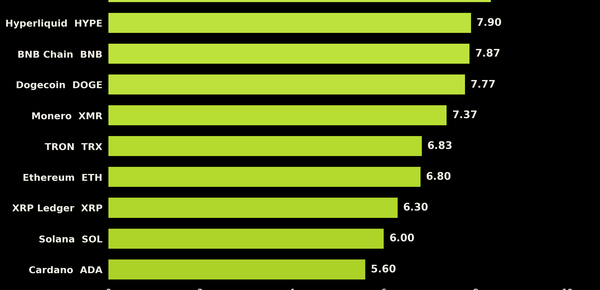
Figure 1. Quantum Vulnerability Score by chain. Score range 0 to 10; higher equals more vulnerable. Source: qLABS Research, April 2026.
Headline finding
Bitcoin is the most quantum-vulnerable Layer-1 blockchain in the top-10 cohort. It combines the maximum exposed-key cohort, maximum economic value at risk, the longest harvest-now-decrypt-later window in the set, and governance and technical challenges that make it difficult to put forward a migration roadmap acceptable to the Bitcoin community.
Cardano emerges as the least vulnerable, driven by full preparedness across IOHK research running since 2018, the Cardano Nightstream collaboration with Google and Microsoft, and an Intersect-governed CIP process.
Why this matters now
Three developments in the past twelve months have compressed the planning horizon for post-quantum migration. Gidney (May 2025) cut the qubit estimate for breaking RSA-2048 from 20 million to under 1 million. Iceberg Quantum's Pinnacle architecture (February 2026) further reduced the estimate to under 100,000 physical qubits using QLDPC codes. Oratomic and Caltech (March 2026) showed that 256-bit elliptic curve cryptography, the scheme securing every chain in this index, could be broken with approximately 26,000 neutral-atom qubits in roughly ten days.
Published 2026 estimates for breaking 256-bit ECC are now roughly 1,100 to 2,300 logical qubits, depending on circuit design and the space-time tradeoff. Google has set a 2029 internal deadline for completing its post-quantum migration, with Cloudflare aligned to the same date.

Figure 2. Twelve months of compounding threat updates. Each milestone reduces the engineering bar for a cryptographically-relevant quantum computer.
Public blockchains are disproportionately exposed because their security model places cryptographic commitments on an immutable ledger. Unlike TLS sessions, which are ephemeral, a blockchain address or validator key remains discoverable decades after creation. The combination of long-lived cryptographic exposure plus a shortening probability distribution on the arrival of a cryptographically-relevant quantum computer motivates a rigorous cross-chain comparison.
Ranking
Computed under the v2.1 rubric (binary SSV and PKE, three-question MU, banded EVR and HNDL). Scores are the weighted sum of five criteria on a 0-to-10 scale.
- 1 · Bitcoin (BTC) · QVS 8.33. No fully quantum-safe roadmap; largest exposed-key cohort; $1.55T at risk.
- 2 · Hyperliquid (HYPE) · QVS 7.90. No foundation roadmap or community discussion; offset by youngest HNDL.
- 3 · BNB Chain (BNB) · QVS 7.87. No foundation roadmap; large hosted economic footprint.
- 4 · Dogecoin (DOGE) · QVS 7.77. No formal roadmap; long HNDL window; cultural reuse.
- 5 · Monero (XMR) · QVS 7.37. No PQC roadmap; privacy reduces but does not eliminate exposure.
- 6 · TRON (TRX) · QVS 6.83. Founder commitment but no formal proposal yet.
- 7 · Ethereum (ETH) · QVS 6.80. Full preparedness; pq.ethereum.org plus 2029 L1 target.
- 8 · XRP Ledger (XRP) · QVS 6.30. Full preparedness; Ripple four-phase plan to 2028.
- 9 · Solana (SOL) · QVS 6.00. A post-quantum roadmap published, while still in the research phase.
- 10 · Cardano (ADA) · QVS 5.60. Full preparedness; IOHK research since 2018; Nightstream collaboration.
Quotable findings
On Bitcoin: “Bitcoin is uniquely exposed because it is the No. 1 chain without a good solution for the quantum threat and a clear roadmap on how to migrate. The chain that anchors the most value in crypto is also the chain struggling to coordinate a migration response.”
On preparedness as the binding signal: “Chains with full preparedness scores under our rubric (Ethereum, Solana, XRP Ledger, and Cardano) separate themselves most clearly on the migration axis. Under our weighting, full preparedness can reduce QVS by up to 2.5 points relative to a fully unprepared peer, making roadmap publication and visible migration activity the single highest-leverage variable in the index.”
On the silent middle: “BNB Chain, Dogecoin, TRON, and Monero form the highest-leverage advocacy cohort in the index. Each shows at least some visible sign of preparedness, but none has yet reached full roadmap status. A foundation blog post, working group, or formal proposal could move any of them by 3.33 MU points and materially lower overall QVS.”
On Cardano: “Cardano is the least-vulnerable top-10 chain, driven by IOHK research running since 2018, the IO Research vision document submitted to Intersect in February 2025, and the Cardano Nightstream collaboration with Google and Microsoft announced February 2026.”
Key findings
Finding 1. Preparedness is the single most important differentiator.
Chains with a published roadmap, plus acknowledged developer risk, plus active community discussion (Ethereum, Solana, XRP Ledger, Cardano) are separated cleanly from chains without these (Bitcoin, BNB Chain, Dogecoin). The binary SSV and PKE criteria do not discriminate within the top-10. EVR separates large-cap from small-cap. HNDL adds the most signal for chains with long exposure histories and known legacy key cohorts.
Finding 2. Bitcoin leads the index.
Bitcoin reaches the top of the ranking by combining maximum economic exposure ($1.55 trillion market cap), the largest permanently-exposed public-key cohort in any chain (1.6 to 1.9 million BTC in P2PK), the longest HNDL window (17 years), and structural as well as technical challenges in converging on a credible migration roadmap.
Finding 3. Hyperliquid is uniquely absent from the quantum-readiness conversation.
Every other top-10 Layer 1 shows at least one visible sign of quantum-preparation activity. Hyperliquid does not. As of the review date we found no public PQC roadmap, no public leadership acknowledgment, and no visible migration discourse in the official foundation, docs, or HIP channels.
Finding 4. BNB Chain is the clearest case of preparedness-by-omission.
BNB Chain is the chain most likely to move down the ranking with a single foundation action: a public PQC roadmap. Binance and the BNB Chain Foundation have the institutional capacity to publish such a roadmap. As of April 2026, no such document exists.
Finding 5. The silent-middle cohort is the highest-leverage advocacy zone.
BNB Chain, Dogecoin, and Monero sit in the upper partial-preparedness band, while TRON sits just below it. Each scores partial credit on the preparedness rubric. A foundation blog post, working group, or formal research program could move these chains by 3.33 points on MU and several hundred basis points on QVS. Solana's publication of a quantum-readiness roadmap during this research illustrates how quickly visible preparedness can change a chain's ranking.
Finding 6. TRON shows the rubric responds to founder commitment.
Justin Sun's April 14, 2026 commitment to integrate NIST PQC signatures (ML-DSA, SLH-DSA, FN-DSA) satisfies Q2 (developer or founder acknowledgment) and triggers Q3 (community discussion), but does not by itself satisfy Q1, which requires a TIP or governance proposal. The rubric rewards intent at the moment intent becomes public, and rewards delivery only when intent moves from announcement to artifact.
Finding 7. Cardano is least vulnerable through compounding preparedness.
ADA's QVS of 5.60 reflects full preparedness across all three rubric questions: IOHK research running since 2018, the February 2025 IO Research vision document submitted to Intersect, and the February 2026 Cardano Nightstream collaboration with Google and Microsoft. Combined with a small native EVR (about $9.4 billion) and a shorter overall exposure window, Cardano sits clearly at the bottom of the ranking.
1. Methodology
1.1 Scope and chain selection
1.1.1 Selection criteria
We include Layer-1 blockchains subject to the following tests, applied as of April 30, 2026:
- Native L1: Operates its own consensus, not a rollup, sidechain, or appchain secured by another L1.
- Native asset traded on spot markets: Has a liquid base asset whose market capitalization is publicly reported across at least two major market data providers (CoinGecko and CoinMarketCap).
- Non-stablecoin: Excludes stablecoins (USDT, USDC) and wrapped or derivative assets.
- Non-L2: Excludes optimistic and zero-knowledge rollups, state channels, and sidechains.
- Live mainnet: Mainnet operating at the date of snapshot.
1.1.2 Chain list (market cap cutoff April 30, 2026)
Ranked by market capitalization. Market-cap values are indicative and sourced from CoinMarketCap coin pages at the snapshot date.
- 1. Bitcoin (BTC), ~$1.51T
- 2. Ethereum (ETH), ~$270B
- 3. XRP Ledger (XRP), ~$84B
- 4. BNB Chain (BNB), ~$82B
- 5. Solana (SOL), ~$47B
- 6. TRON (TRX), ~$30B
- 7. Dogecoin (DOGE), ~$16B
- 8. Hyperliquid (HYPE), ~$10B
- 9. Cardano (ADA), ~$8.8B
- 10. Monero (XMR), ~$6.9B
Market-cap positions 8 through 10 are tightly clustered and could re-order daily. This does not materially affect vulnerability scoring since EVR bands are wide enough to absorb plus-or-minus 30 percent moves.
1.1.3 Exclusions
- Stablecoins (USDT, USDC): Not L1s; inherit whichever L1 hosts them.
- Bitcoin Cash: Uses the same core quantum-relevant cryptographic stack as Bitcoin for user keys and a very similar security model overall, so including both would double-count one design lineage rather than improve coverage.
- Chains below top-10 at snapshot date: Algorand and Aptos are notable for active PQC work and may warrant inclusion in a “notable PQC-adopter” extended index.
- L2s and rollups: Inherit the L1's base-layer cryptography.
1.2 Scoring framework
Each chain receives a Quantum Vulnerability Score (QVS) on a 0-to-10 scale. Higher equals more vulnerable. QVS is the weighted sum of five criteria.
QVS = 0.25 · SSV + 0.20 · PKE + 0.20 · EVR + 0.25 · MU + 0.10 · HNDL
- SSV: Signature Scheme Vulnerability (binary). Does the chain rely on a quantum-vulnerable signature scheme? ECDSA, EdDSA, Schnorr, and BLS all break under Shor at comparable logical-qubit costs.
- PKE: Public Key Exposure (binary). Does the protocol permit classical key exposure for any cohort of users?
- EVR: Economic Value at Risk (market-cap banded). Total market capitalization of the native asset.
- MU: Migration Unpreparedness (three-question rubric). Scored from 0 (fully prepared) to 10 (fully unprepared).
- HNDL: Harvest-Now-Decrypt-Later Exposure (calendar-age banded). Years of cryptographic commitments accumulated on-chain.

Figure 3. Criterion weights, anchored to Mosca's theorem (X + Y > Z). MU and SSV carry the heaviest weight at 25 percent each.
Weights were chosen with reference to Mosca's theorem (X + Y > Z implies migration is urgent, where X is migration time, Y is secrecy horizon, and Z is CRQC arrival time):
- MU (25%). Determines X in Mosca's theorem. A vulnerable chain that is actively migrating is materially safer than one that is not. Under the simplified rubric, MU is the primary differentiator across otherwise-similar chains.
- SSV (25%). Primary attack surface. Determines whether the chain is vulnerable at all. Under the binary rubric, any non-PQC chain scores maximum.
- PKE (20%). Determines the attack race condition. Hashed-key-commitment addresses give defenders a time window. Raw public-key addresses do not.
- EVR (20%). Calibrates absolute harm. $1T at risk is qualitatively different from $10B.
- HNDL (10%). Long-tail risk from historically exposed keys. Sets a floor on achievable safety.
Sensitivity analysis was performed across alternative weightings. All four schedules tested produce the same chain at the bottom (Cardano) and Bitcoin at the top.
1.3 Scoring bands
Every criterion is scored using explicit, reproducible rules. A scorer working from the same primary sources should produce an identical score.
Signature Scheme Vulnerability (SSV), binary
- Score 0. Native PQC (Dilithium, Falcon, SPHINCS+, or hybrid) as default signature on mainnet.
- Score 10. Any classical signature scheme (ECDSA, EdDSA, Schnorr, ring-signature over Ed25519) as mainnet default.
Rationale. Shor's algorithm breaks ECDSA, EdDSA, Schnorr, and BLS at comparable logical-qubit costs. In the current top-10 every chain scores 10. The binary rubric exists so future editions can register a zero when a native-PQC chain enters the top-10.
Public Key Exposure (PKE), binary
- Score 0. PQC public keys, or hashed commitments of classical keys with mandatory one-time-use at the protocol level.
- Score 10. Any on-chain artifact from which an attacker can recover a classical public key (direct P2PK, reused P2PKH, validator aggregation keys, or transaction signatures that reveal the signer key).
Rationale. Aggarwal et al. isolate the broadcast-to-confirmation window as the Shor's-attack race. Any chain whose protocol permits classical key exposure scores 10, because at least some cohort of users carry that exposure. Privacy-by-default constructions (Monero stealth addresses, Ethereum smart-contract wallets) reduce the size of the exposed cohort but do not eliminate it, so they do not change the binary score; they are captured in qualitative discussion.
Economic Value at Risk (EVR), market-cap banded
- 0–1. cap < $1B
- 2–3. $1B ≤ cap < $10B
- 4–5. $10B ≤ cap < $50B
- 6–7. $50B ≤ cap < $200B
- 8–9. $200B ≤ cap < $1T
- 10. cap ≥ $1T
EVR is anchored to the total market capitalization of the native asset.
Migration Unpreparedness (MU), three-question rubric
Preparedness is evaluated on three yes-or-no questions. Each No adds 10/3 points to MU, so MU ranges from 0 (fully prepared) to 10 (fully unprepared).
- Is a quantum-migration roadmap publicly published (by the foundation, core dev team, or equivalent governance body)? A research program, a merged protocol proposal (BIP, EIP, CIP), or a formally signed document counts as Yes. Third-party projects targeting the chain do not count.
- Have key developers or founders publicly acknowledged post-quantum risk (in a blog post, conference talk, podcast, mailing list thread, or formal publication)?
- Is the community actively discussing migration (X/Twitter, GitHub issues, governance proposals, podcasts, Discord/Telegram threads, or internal fora that the public can access)?
- 3 Yes / 0 No. MU = 0
- 2 Yes / 1 No. MU = 3.33
- 1 Yes / 2 No. MU = 6.67
- 0 Yes / 3 No. MU = 10
Rationale. The three questions are designed to be checkable by a non-specialist from public sources in under 30 minutes per chain. They map the has-anyone-looked-at-this axis from ignored to actioned without requiring judgment about roadmap depth.
HNDL Exposure, calendar-age banded
- 0–1. < 2 years, little historical data to harvest.
- 2–3. 2 to <5 years, no known mass-exposed key cohorts.
- 4–5. 5 to <10 years, moderate historical exposure.
- 6–7. ≥ 10 years, exposure mitigated by protocol design or key rotation.
- 8–9. ≥ 10 years, major exposed cohorts.
- 10. ≥ 10 years, major exposed cohorts with high value concentration (e.g. Satoshi-era P2PK).
1.4 Scoring process
For each chain, two scorers independently assigned criterion scores working from the primary sources documented in section 6. Under the simplified v2.1 rubric (binary SSV and PKE, three-question MU, banded EVR and HNDL), inter-rater agreement reached zero-point discrepancy on SSV, PKE, and MU, and at most one-point discrepancy on EVR and HNDL. All final scores are at no greater than one-point inter-rater distance.
2. Per-chain analysis
2.1 Bitcoin (BTC)

- SSV = 10. ECDSA secp256k1 and Schnorr (BIP-340 Taproot). Both quantum-vulnerable.
- PKE = 10. Approximately 1.6 to 1.9 million BTC, about 8 percent of supply, sit in legacy P2PK outputs with permanently exposed public keys. Additional cohorts become exposed on first spend.
- EVR = 10. Approximately $1.55 trillion market cap, the largest in the top-10.
- MU = 3.33. Several proposals exist to harden Bitcoin (e.g. BIP-360), but none of them fully solve the quantum vulnerability problem (i.e. moving to a true PQC scheme). Under BIP-360 the public key is initially hidden via a commitment but is still revealed at spend time, so from the miner's perspective it is ultimately exposed and not fully quantum-safe. Several Bitcoin core developers and stakeholders have publicly acknowledged the issue and voiced concern. The community is actively discussing solutions.
- HNDL = 10. Oldest chain in the set at 17 years (2009 genesis). Houses the largest and highest-value exposed-key cohort in crypto.
Weighted QVS = 8.33
2.2 BNB Chain (BNB)

- SSV = 10. ECDSA secp256k1, EVM-compatible.
- PKE = 10. EVM-style account model; keys revealed on spend.
- EVR = 6. BNB market cap approximately $82 billion plus hosted TVL and stablecoin supply.
- MU = 6.67. No public PQC roadmap from BNB Chain Foundation or Binance. No public statements specifically addressing BSC/BNB quantum migration. Third-party crypto-research posts and broader EVM community debates touch BNB tangentially.
- HNDL = 5. BNB Beacon Chain genesis 2019, BSC 2020. Moderate exposure base.
Weighted QVS = 7.87
2.3 Hyperliquid (HYPE)

- SSV = 10. User-facing transactions on HyperCore and HyperEVM use ECDSA secp256k1 via EIP-712 typed-data signing.
- PKE = 10. EVM-style 20-byte hashed addresses. Keys revealed on first spend.
- EVR = 4. Native HYPE market capitalization approximately $10 billion. Substantial open interest and 24-hour volume on Hyperliquid perps amplify downstream harm.
- MU = 10. Hyperliquid Foundation has published no PQC roadmap, no PQ research program, no merged protocol proposal, no PQC testnet. No public statements on quantum vulnerability from the core team identified. No active community discussion or concern about post-quantum preparedness on main platforms.
- HNDL = 1. Approximately 1.5 years since mainnet staking launch (December 30, 2024). Shortest history of any top-10 chain.
Weighted QVS = 7.90
2.4 Dogecoin (DOGE)

- SSV = 10. ECDSA secp256k1, fork-of-a-fork lineage.
- PKE = 10. Dogecoin permits classical public-key exposure in its legacy Bitcoin-derived UTXO/script model. Users with exposed or reused keys are quantum-vulnerable, even though the chain's short block time reduces early on-spend risk.
- EVR = 4. Approximately $16 billion market cap.
- MU = 6.67. No Dogecoin Improvement Proposal or governance-approved roadmap. No formal core-maintainer public statement. Active community discussion in multiple GitHub issues covering quantum-resistant integration. Foundation contributors quoted in trade press on experimental PQC transactions.
- HNDL = 8. 11 years old (2013 genesis). Substantial exposed-key cohorts from the early tipping era.
Weighted QVS = 7.77
2.5 TRON (TRX)

- SSV = 10. ECDSA secp256k1, EVM-compatible.
- PKE = 10. EVM-style account model.
- EVR = 5. TRX native market cap approximately $30 billion. Hosted USDT supply on TRON in the $70 billion-plus range amplifies downstream harm.
- MU = 3.33. No formal TIP or governance proposal filed. Justin Sun publicly committed TRON to integrating NIST-standardized PQC signatures (ML-DSA, SLH-DSA, FN-DSA) on April 14, 2026. Industry coverage in The Block, Bitcoin News, Unchained.
- HNDL = 5. 7 years old (2018 mainnet).
Weighted QVS = 6.83
2.6 Monero (XMR)

- SSV = 10. Ed25519-based ring signatures (CLSAG). Broken by Shor at comparable logical-qubit costs to ECDSA.
- PKE = 10. Stealth addresses plus ring signatures materially reduce the size of the exposed-key cohort, but do not eliminate classical-curve exposure at the protocol level.
- EVR = 3. Native XMR market cap approximately $6.9 billion. No hosted stablecoin float, no smart-contract TVL.
- MU = 6.67. Seraphis and Jamtis operate within existing elliptic-curve primitives and are not PQC. Monero Research Lab documents recognize the future quantum threat in protocol-design discussions. Active discussion in MRL issues, Reddit, Monero Village at DEF CON.
- HNDL = 6. 12 years old (April 2014 genesis). Stealth-address one-time-use outputs and ring signatures materially reduce exposed-key accumulation despite long calendar age.
Weighted QVS = 7.37
2.7 Ethereum (ETH)

- SSV = 10. ECDSA secp256k1 for EOAs; BLS12-381 for consensus-layer validator signatures. Neither is PQC.
- PKE = 10. EOAs reveal public keys upon spend. BLS validator keys are exposed permanently on the beacon chain.
- EVR = 8. Native-asset market cap approximately $270 billion.
- MU = 0. pq.ethereum.org hub launched March 25, 2026. Ethereum Foundation has set a 2029 L1 PQC target. Weekly post-quantum interoperability devnets with 10+ client teams. Vitalik Buterin's quantum-emergency hardfork research post. Active discussion in ethresear.ch, Devconnect panels.
- HNDL = 7. 10 years old. Extensive pre-AA EOA population where keys have been exposed across numerous spends.
Weighted QVS = 6.80
2.8 XRP Ledger (XRPL)

- SSV = 10. ECDSA secp256k1 default, Ed25519 optional. Both quantum-vulnerable.
- PKE = 10. On-spend key revelation. Native key rotation (RegularKey amendment) reduces repeated-reuse exposure but does not remove the binary exposure classification.
- EVR = 6. Approximately $84 billion market cap.
- MU = 0. Ripple four-phase plan published April 21, 2026 targeting full PQC deployment by 2028. Ripple CTO public statements; Phase-2 vulnerability assessment. Active discussion in XRPL dev community, CoinDesk and Cryptotimes coverage.
- HNDL = 6. 13 years old (2012 genesis). Native key rotation built in from day one reduces exposed-key accumulation relative to Bitcoin.
Weighted QVS = 6.30
2.9 Solana (SOL)

- SSV = 10. Standard Solana user signing relies on Ed25519, which is quantum-vulnerable under Shor.
- PKE = 10. Solana addresses are the raw Ed25519 public key for standard accounts. No hash-commitment layer.
- EVR = 5. Approximately $47 billion native market cap plus substantial ecosystem TVL.
- MU = 0. Solana Foundation published a public quantum-readiness roadmap on April 27, 2026. The post acknowledges quantum risk, describes active migration research by Anza and Firedancer, and outlines a three-step path covering continued research, new-wallet adoption, and migration of existing wallets.
- HNDL = 5. 5 years old (2020 mainnet). Shorter history than L1 peers.
Weighted QVS = 6.00
2.10 Cardano (ADA)

- SSV = 10. Ed25519 default; extended-UTXO model.
- PKE = 10. Hashed script addresses. Keys revealed on spend similar to Bitcoin P2PKH.
- EVR = 3. Approximately $9.4 billion market cap.
- MU = 0. IOHK long-term quantum-resistance research program running since 2018. Ouroboros Praos PQ variant under active research. IO Research vision document submitted to Intersect Product Committee in February 2025. Cardano Nightstream collaboration with Google and Microsoft announced February 13, 2026, covering phased PQC deployment with Mithril checkpoints. Charles Hoskinson public statements; IOHK blog series. Active discussion in Cardano Forum, CIP discussions, Voltaire governance-era discourse.
- HNDL = 5. Cardano has been live since 2017, giving it a moderate HNDL window. Hashed addresses and the extended-UTXO model reduce exposed-key accumulation relative to Bitcoin and Ethereum, but do not remove historical cryptographic exposure.
Weighted QVS = 5.60
3. Cross-chain views
The figures below cut the same scores along three different axes. The criterion-level heatmap (Figure 4) shows where each chain's score is concentrated. The preparedness-gap chart (Figure 5) isolates the MU axis, the binding differentiator. The HNDL-by-age chart (Figure 6) shows how the long-tail risk concentrates in older chains.

Figure 4. Criterion-level heatmap. SSV and PKE are uniform (binary 10); EVR, MU, and HNDL drive within-set differentiation.

Figure 5. Preparedness gap on the MU axis. The four full-response chains (Ethereum, Solana, XRP Ledger, Cardano) are separated from the rest by 3.33 points or more.

Figure 6. HNDL exposure by chain age. Bitcoin is the outlier in both dimensions; Hyperliquid sits at the opposite corner.
4. Limitations
- Binary SSV and PKE compress information. Every top-10 chain scores 10 on both. Qualitative differentiation is preserved in narrative.
- The three-question preparedness rubric rewards intent over delivery. A chain that publishes a roadmap but ships nothing scores the same as a chain that ships against the roadmap.
- Inter-rater agreement was achieved on a two-scorer process. A larger panel would tighten confidence intervals.
- The weight schedule is defended but not derived. Alternative schedules produce different orderings.
- The index scores quantum vulnerability, not overall security.
- CRQC arrival probability is exogenous. The Global Risk Institute 2025 range of 28 to 49 percent within ten years is adopted as a planning prior.
5. Conflict-of-interest disclosure
qLABS, which authored this index, is a quantum-native crypto foundation building post-quantum infrastructure starting with the Hyperliquid ecosystem. Hyperliquid appears in the ranking. The following safeguards apply.
- Hyperliquid is scored against the same five criteria, the same rubrics, and the same primary-source evidence standard as every other chain.
- Hyperliquid's MU score of 10 reflects the absence of a Hyperliquid Foundation roadmap, the absence of public developer acknowledgment, and the absence of wider community discussion on publicly available platforms. qLABS's separate, third-party PQC work is not part of that discussion.
- Hyperliquid's QVS of 7.90 sits at #2 with chains both above and below it. The ranking is determined by the rubric, not by author preference.
- Readers are encouraged to rescore Hyperliquid directly using the public rubrics in section 1, and to contact qLABS with primary-source evidence that should move any criterion.
6. Key primary sources
- Aggarwal, D., Brennen, G. K., Lee, T., Santha, M., Tomamichel, M. Quantum attacks on Bitcoin, and how to protect against them. arXiv:1710.10377, October 2017. https://arxiv.org/abs/1710.10377
- Q-Day Just Got Closer. The Quantum Insider, March 31, 2026. https://thequantuminsider.com/2026/03/31/q-day-just-got-closer-three-papers-in-three-months-are-rewriting-the-quantum-threat-timeline/
- Gidney, C. How to factor 2048-bit RSA integers with less than a million noisy qubits. https://arxiv.org/abs/2505.15917
- Iceberg Quantum. Pinnacle Architecture. https://arxiv.org/abs/2602.11457
- Google. Cryptography Migration Timeline. https://blog.google/innovation-and-ai/technology/safety-security/cryptography-migration-timeline/
- Google Quantum AI. Securing Elliptic Curve Cryptocurrencies against Quantum Vulnerabilities: Resource Estimates and Mitigations. March 30, 2026. https://quantumai.google/static/site-assets/downloads/cryptocurrency-whitepaper.pdf
- Nature. It's a real shock: quantum-computing breakthroughs pose imminent risks to cybersecurity. https://www.nature.com/articles/d41586-026-01054-1
- TIME. AI Helped Spark a Quantum Breakthrough. April 7, 2026. https://time.com/article/2026/04/07/ai-quantum-computing-advance/
- Citi Institute. Quantum Threat. January 2026. https://www.citigroup.com/rcs/citigpa/storage/public/Citi_Institute_Quantum_Threat.pdf
- Federal Reserve. Harvest Now, Decrypt Later. FEDS 2025-093. https://www.federalreserve.gov/econres/feds/harvest-now-decrypt-later-examining-post-quantum-cryptography-and-the-data-privacy-risks-for-distributed-ledger-networks.htm
- NIST FIPS 203 / 204 / 205 (final, August 2024). https://csrc.nist.gov/pubs/fips/203/final
- Project Eleven. Q-Day Prize award. April 24, 2026. https://thequantuminsider.com/2026/04/24/project-eleven-q-day-prize-quantum-ecc-attack/
- Cardano Nightstream collaboration. February 13, 2026. https://coinalertnews.com/news/2026/02/14/cardano-google-microsoft-post-quantum-security
- Ripple four-phase XRPL plan. April 21, 2026. https://www.coindesk.com/markets/2026/04/21/ripple-wants-the-xrp-ledger-to-be-quantum-proof-by-2028-here-is-its-plan
- Justin Sun. TRON post-quantum upgrade plan. April 14, 2026. https://www.theblock.co/post/397572/justin-sun-says-tron-launching-post-quantum-upgrade-plan
- CoinShares. Quantum Vulnerability in Bitcoin. https://coinshares.com/insights/research-data/quantum-vulnerability-in-bitcoin-a-manageable-risk/
- BIP-360 (Pay-to-Merkle-Root / P2QRH). https://bip360.org/
- BTQ Technologies. BIP-360 deployment on Bitcoin Quantum Testnet v0.3.0. https://www.prnewswire.com/news-releases/btq-technologies-announces-first-deployment-of-bip-360-on-bitcoin-quantum-testnet-v0-3-0--302718592.html
- Global Risk Institute. Quantum Threat Timeline Report 2025. https://globalriskinstitute.org/publication/quantum-threat-timeline-report-2025b/
Press contact
qLABS Research. Reproducibility appendix and per-chain scoring worksheet available on request. Researchers and journalists are encouraged to rescore any chain directly using the public rubrics in section 1, and to contact qLABS with primary-source evidence that should move any criterion.